New Study Predicts Slower Global Urban Expansion by 2100
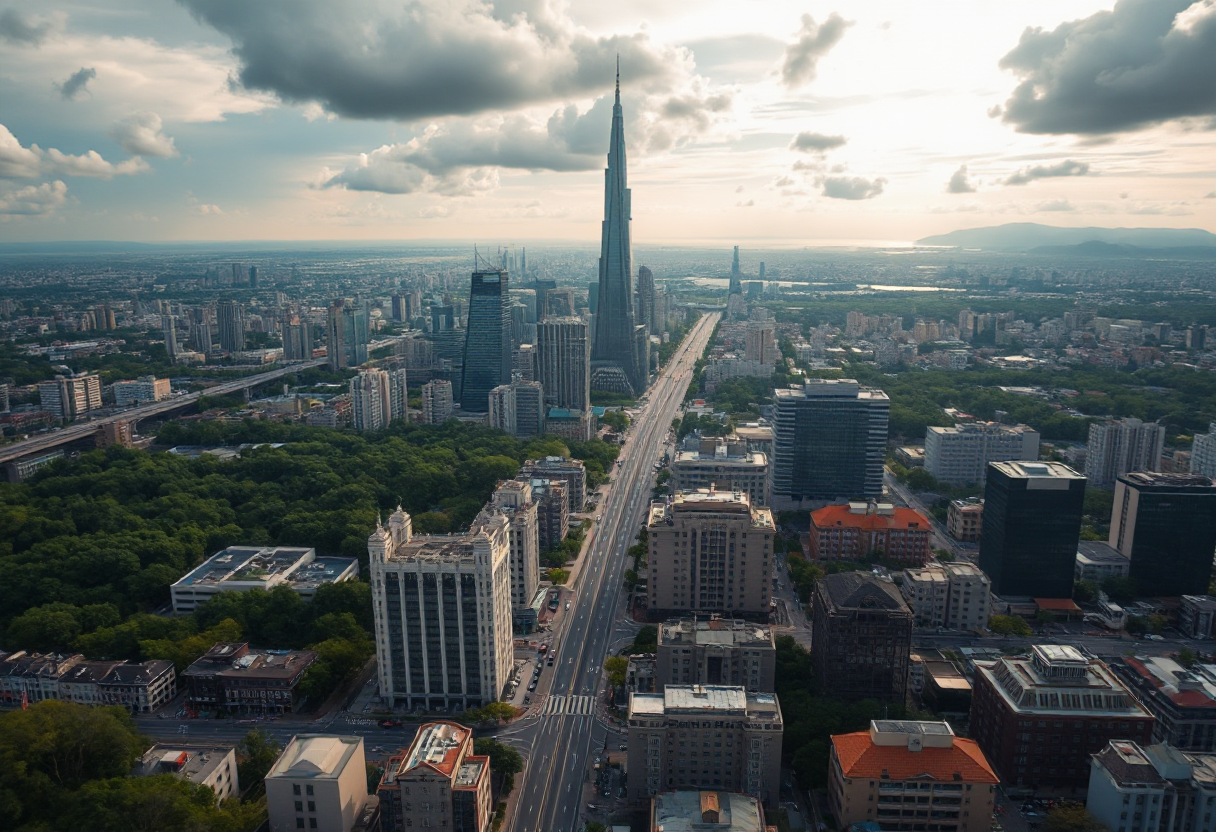
A new study suggests that global urban growth will slow down by the end of the century. Although cities are expanding rapidly, researchers estimate that only thirty-eight percent of the world's population will live in cities with over one million residents by twenty-one hundred. This is significantly fewer than previous estimates. By using satellite imagery, scientists found that city growth follows a life cycle. Cities in developing countries grow quickly, but this growth slows as countries become more urbanized. While large cities offer higher productivity, they also bring longer traffic delays and greater health risks.
A new scientific study suggests that the rapid expansion of global cities might slow down by the end of this century. Although current trends show massive migration, researchers expect urban growth to decelerate over the coming decades. By 2100, only 38 percent of the global population will reside in cities exceeding one million inhabitants. This projection, which was published in PNAS, represents about 450 million fewer residents than standard trend models predict. This difference is substantially larger than the entire population of the United States. In 1975, only 11 percent of people lived in these large cities, compared to 24 percent today.
The research was conducted by scientists at the Complexity Science Hub and ETH Zurich. To track growth consistently, the team utilized satellite imagery and census records instead of administrative boundaries. According to researcher Andrea Musso, traditional boundaries are often misleading because cities expand beyond official limits. For instance, Paris is much larger than its administrative boundary, and New York is not just Manhattan. Consequently, the researchers divided the world into grid cells of roughly one square kilometer to monitor growth. They identified whether each cell was urban or rural based on population and building density.
The study reveals that urban systems follow a specific life cycle that determines their growth rates. In developing nations, large cities grew 7.3 percent faster than smaller towns between 1975 and 2025. People migrated to these massive hubs because employment opportunities, hospitals, and universities are usually concentrated there. However, this powerful magnetic pull weakens once a country achieves a higher level of urbanization. Consequently, cities in Europe and the Americas grew at the same rate as the national average. In large cities, people spend over twice as much time in traffic compared to small towns. Furthermore, residents are nearly three times more likely to contract diseases, yet they are twice as productive. According to Frank Neffke, this economic driver loses momentum as urbanization increases.
Take a position. Out loud, if you can.
Four ways to start. Pick one and try saying it before you scroll on.
Tip · Record yourself, use in a notebook, or practice with a language partner.
By 2100, what percentage of the world's population is projected to live in cities with more than one million inhabitants?
Non-defining Relative Clauses
Non-defining relative clauses add extra information about a noun. They are separated by commas and use relative pronouns like 'which' or 'who'.
“This projection, which was published in PNAS, represents about 450 million fewer residents than standard trend models predict.”
What to know · B2
Try saying this aloud
Scenario: Discussing research findings or trend forecasts with colleagues.
- 01“expect urban growth to decelerate”
- 02“standard trend models”
- 03“loses momentum”
Register tip · formal
🔑Key Phrases
Used to introduce new research results in formal writing.
A new scientific study suggests that sleeping patterns affect memory retention.
Expresses a prediction about a rate of change decreasing.
Economists expect inflation to decelerate next year.
Contrasts the chosen methodology with a common alternative.
They mapped the ecosystem using natural features instead of administrative boundaries.
A formal way to describe a population threshold.
The country has several cities exceeding one million inhabitants.
Describes a process of correlation where speed decreases as a variable grows.
The project loses momentum as complexity increases.
Article Audio — Kokoro TTS
New Study Predicts Slower Global Urban Expansion by 2100
💬Discussion Questions
Open-ended questions to talk or write about — alone, with a partner, or in class.
- 1
Do you think the benefits of living in a large city, such as high productivity, outweigh the negative aspects like traffic and health risks?
Evaluate - 2
How might your own city or town change in the future if urban growth slows down globally?
Predict
Adapted from Phys.org · Read the original. LectoPress rewrites the facts as original graded-reader text for language learners.
Get stories at your level, every day
B2 · EN · delivered to your inbox · unsubscribe any time
Customize language, level & topics → full preferences